Home Portfolio Membranes Aqua-Aerobic® MBR
Membranes — Membrane Bioreactor

Aqua-Aerobic® MBR
Membrane Bioreactor

The membrane bioreactor (MBR) integrates aerobic biological treatment with submerged ultrafiltration membrane filtration in a single compact process — delivering the highest quality effluent suitable for direct reuse in a smaller footprint than conventional systems.

Aqua-Aerobic® MBR — Membrane Bioreactor
< 5 mg/L
Effluent BOD
0.04 μm
Pore Size
40–50% Smaller
Footprint vs CAS
Direct Reuse
Effluent Quality
Log 6+
Pathogen Removal

Biological treatment and membrane filtration in a single process

Aqua-Aerobic® MBR combines the activated sludge process with ultrafiltration membranes immersed directly in the biological tank. The biomass operates at much higher concentrations than conventional activated sludge (8,000–15,000 mg/L MLSS vs 2,000–4,000 mg/L), resulting in smaller tank volume and superior removal efficiency.

Hollow-fiber membranes with 0.04 μm pores act as an absolute barrier — retaining 100% of biological sludge and providing perfect solid-liquid separation, regardless of settling conditions. The result is consistently excellent effluent quality even during load variations, suitable for direct reuse without additional treatment.

Direct Reuse Effluent

BOD < 5 mg/L, TSS ≈ 0 mg/L, and pathogen removal > Log 6, no additional clarifier or tertiary filter needed.

Up to 50% Smaller Footprint

Elimination of secondary clarifier and tertiary filters drastically reduces the required construction area.

Stable Performance Under Load Variations

Effluent quality is independent of sludge settleability — absolute physical barrier provided by membranes.
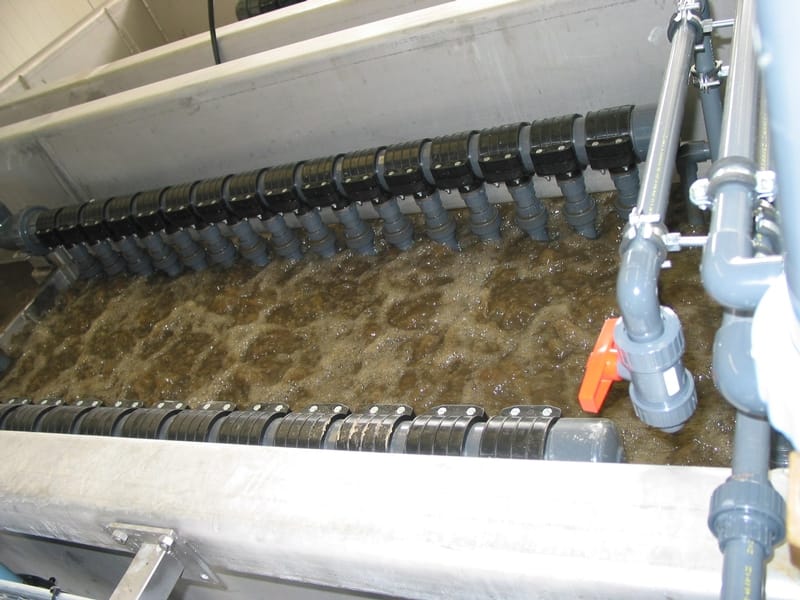
MBR system with submerged membranes in biological tank
Aqua-Aerobic® MBR — membranes submerged in aeration tank

How does the Aqua-Aerobic® MBR work?

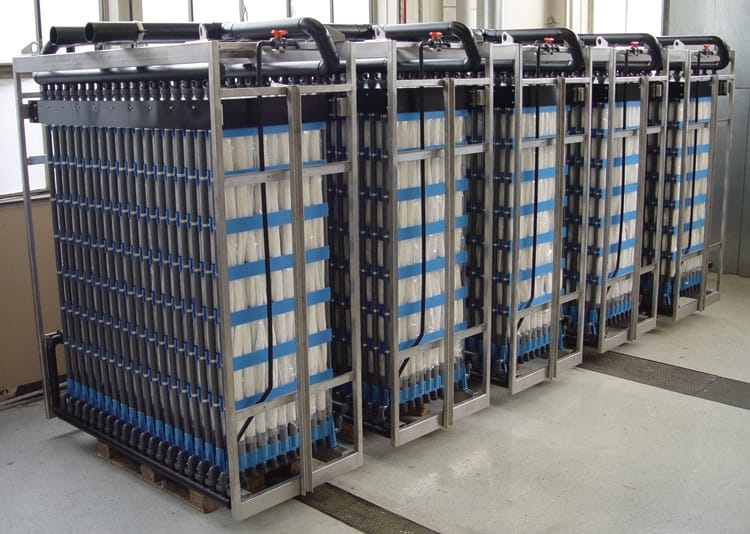
Raw influent enters the biological tank where aerobic biomass (activated sludge) degrades organic matter and nutrients. UF hollow-fiber membranes are immersed directly in the aeration tank and operate under negative pressure (suction), pulling treated effluent through 0.04 μm pores.

Biological sludge is 100% retained by the membranes and remains in the tank, eliminating the need for a secondary clarifier. Periodically, the membranes undergo pneumatic backwashing (air relaxation) and chemical cleaning cycles to maintain flux. The membrane base aeration simultaneously controls fouling (scouring) and supplies O₂ to the biological process.

1. Biological Treatment

Activated sludge at high concentration degrades BOD, COD, nitrogen, and phosphorus in the aeration tank.

2. Membrane Filtration

Submerged UF membranes retain 100% of sludge; highest quality permeate collected externally.

3. Automatic Cleaning

Pneumatic backwash and CIP maintain stable permeate flux throughout membrane service life.

MBR process detail
Integrated MBR process: biological treatment + UF in a single stage

MBR vs Conventional Activated Sludge

Conventional Activated Sludge

  • Requires secondary clarifier
  • Effluent quality depends on settleability
  • Needs additional tertiary filtration for reuse
  • Larger overall footprint
  • Lower membrane cost

Applications of Aqua-Aerobic® MBR

Compact Municipal WWTPs

Complete treatment in a smaller area — ideal for space-constrained municipalities

Large-Scale Water Reuse

Reliable production of high-quality effluent for municipal and industrial reuse

Complex Industrial Effluents

Treatment of effluents with high load variability and composition

High-End Developments

Hotels, hospitals, resorts, and condominiums with integrated treatment and reuse systems

WWTP Upgrades

Modernizing activated sludge systems with increased capacity and effluent quality

Decarbonization Projects

Lower sludge production and possibility of energy and nutrient recovery

Related Technologies

Compact WWTP project with reuse-quality effluent?

Aqua-Aerobic® MBR delivers the best effluent quality in the smallest footprint. Consult our technical team.

Talk to a Specialist Response within 24h